A flat roof usually does not start leaking all at once. More often, it gives warning signs first – a stain spreading across a ceiling tile, bubbling on the surface, standing water after a storm, or flashing that has started to pull away. If you are wondering what causes flat roof leaks, the short answer is that water finds weak points over time. The longer answer matters, especially in Corpus Christi and across the Coastal Bend, where heat, wind, salt air, and heavy rain can speed up roof wear.
Flat roofs are common on commercial buildings, additions, patio covers, and some residential designs because they are practical and cost-effective. But despite the name, they are not truly flat. They need a slight slope, solid drainage, and a roofing system that stays sealed through changing weather. When one part of that system fails, leaks can start small and turn into structural damage, insulation problems, mold growth, and interior disruption.
What Causes Flat Roof Leaks Most Often
The most common cause is water that cannot drain the way it should. On a properly built flat roof, rainwater should move toward drains, scuppers, or gutters. When water sits too long, it puts stress on seams, flashing, and surface materials. In coastal Texas, that problem gets worse when sudden downpours drop more water than the drainage system can move quickly.
Material breakdown is another major cause. Flat roofing systems rely on membranes, coatings, seals, and penetrations all working together. Sun exposure can dry out components. Temperature swings can cause expansion and contraction. Wind can lift vulnerable edges. Over time, even a well-installed roof will develop wear points that need attention.
The key point is that a leak is often a symptom, not the root problem. Water may show up inside far away from the place where it entered. That is why flat roof leak diagnosis should always go beyond patching the visible area.
Drainage Problems and Ponding Water
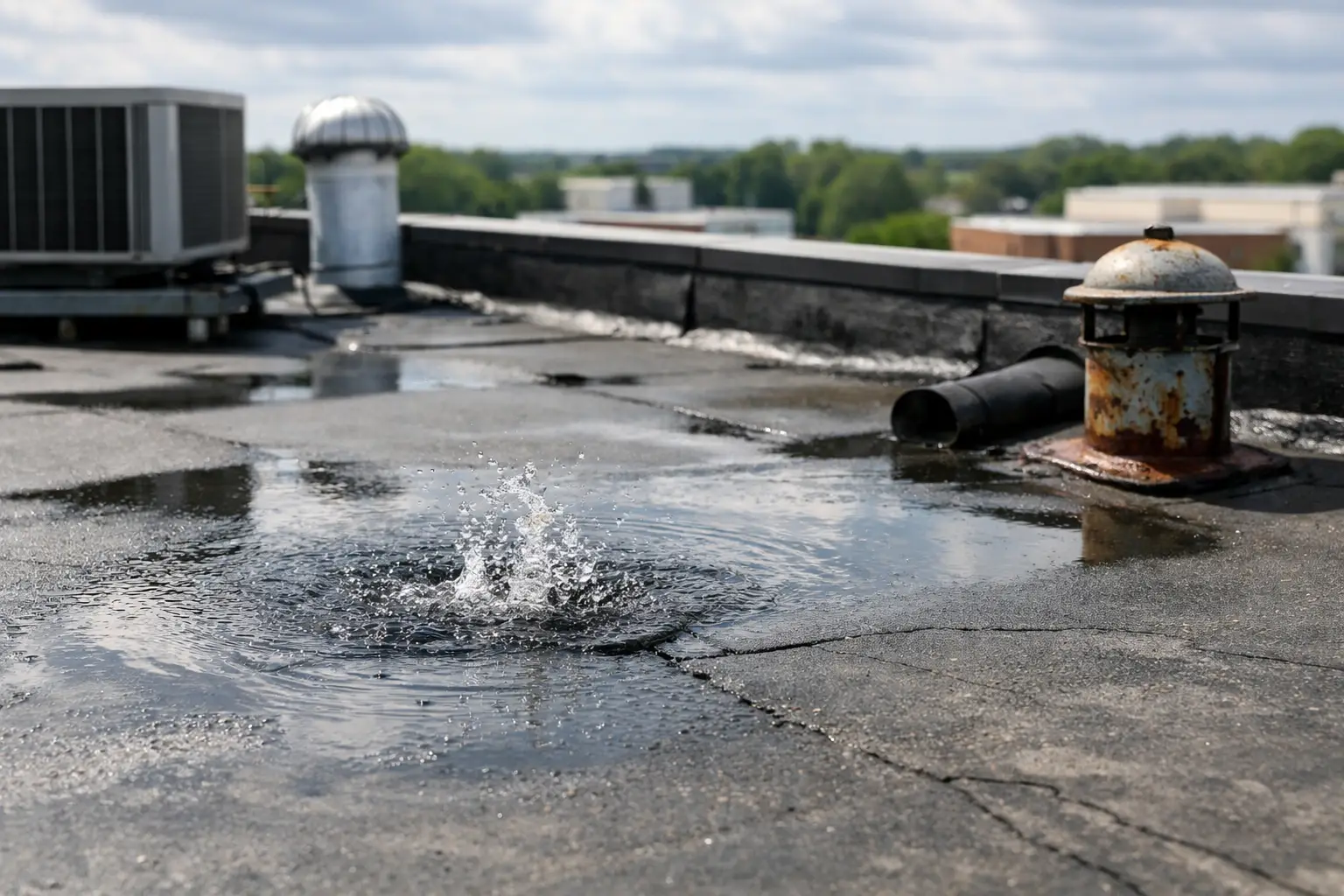
If you ask contractors what causes flat roof leaks on otherwise solid buildings, drainage issues are near the top of the list. Flat roofs depend on positive drainage. When water ponds for more than a day or two after rain, the roof is telling you something is off.
Sometimes the issue is clogged drains or scuppers. Leaves, debris, roofing granules, and dirt can block the exit points and hold water on the roof surface. In other cases, the slope was never adequate to begin with, or parts of the roof deck have settled over time. That low area becomes a collection point, and repeated ponding starts to break down the membrane.
Ponding water is not always an emergency after one storm. But repeated standing water shortens roof life. It can stress seams, invite algae and debris buildup, and increase the chance that small defects turn into active leaks.
Why Coastal Weather Makes Drainage More Critical
Along the Coast Bend, roofs take a different kind of beating than they do inland. Wind-driven rain can force water sideways under loose seams and flashing. Salt in the air can contribute to faster wear on some metal components. After tropical weather, roof drains may also be packed with debris that did not come from the building itself.
That means a flat roof here needs more than basic installation. It needs regular checks and timely maintenance, especially before and after storm season.
Membrane Damage and Open Seams
Most flat roof systems use some type of membrane to keep water out. That might be modified bitumen, TPO, EPDM, or another commercial-grade material. No matter which system is installed, the membrane is only as reliable as its weakest seam, puncture, or attachment point.
Seams can separate with age, poor installation, or movement in the structure. Once that happens, water can enter below the surface and travel before it appears indoors. This is one reason flat roof leaks can seem random. The interior stain may not line up with the actual roof opening.
Punctures are also common. Service traffic, dropped tools, fallen branches, satellite work, HVAC repairs, and even unsecured equipment can damage the roof surface. On commercial buildings, this is especially common around units that are serviced often. A small puncture may not look serious from the roof, but it can allow repeated water intrusion over time.
Flashing Failures Around Edges and Penetrations
Flashing is one of the most leak-prone parts of any roof, and flat roofs are no exception. Wherever the roofing system meets a wall, vent, curb, pipe, skylight, drain, or edge detail, there is a transition that must stay sealed.
These areas move differently than the field of the roof. Heat, wind, and moisture work on them constantly. If the flashing was installed poorly, secured incorrectly, or has simply aged out, water can get in fast. In many leak investigations, the main roofing membrane is still serviceable, but the flashing has failed.
This is also where shortcuts tend to show up. Quick patch jobs around penetrations may hold for a little while, but if the underlying detail is wrong, the leak usually comes back. For property owners, that creates the frustrating cycle of repeated repairs without a lasting fix.
Age, Weathering, and Neglected Maintenance
All roofs age, but flat roofs need more active oversight because water stays in contact with the surface longer than it does on steep-slope systems. UV exposure can dry and crack materials. Sealants can shrink. Coatings can wear thin. Adhesives can weaken.
Neglected maintenance turns ordinary aging into early failure. A roof that might have had years of useful life left can start leaking because small issues were allowed to compound. Debris stays in place, drains clog, seams begin to lift, and nobody spots the trouble until water reaches the inside.
For commercial property managers and business owners, maintenance matters even more because a leak can affect operations, inventory, equipment, and tenant satisfaction. For homeowners, the risk is often hidden damage in insulation, decking, ceilings, and walls before the leak is obvious.
Installation Problems Can Show Up Years Later
Not every flat roof leak is caused by age. Some are rooted in how the roof was installed in the first place. Improper slope, weak seam welding, poor flashing details, wrong fasteners, bad drainage design, and incompatible materials can all create future leak points.
The difficult part is timing. A roof can look fine for a while before those issues show themselves. Then a stretch of heavy rain, summer heat, or high winds exposes the weak areas. That is why quality workmanship matters on the front end. A cheaper install is not cheaper if it leads to repeated service calls and interior repairs.
For buildings in coastal markets, local experience also matters. Roofing details that might perform adequately in a mild climate may not hold up the same way near the Gulf. Wind uplift, moisture exposure, and code requirements all have to be part of the equation.
What Causes Flat Roof Leaks Inside the Building
Sometimes the sign of a leak indoors looks worse than the roof issue itself. Water stains, peeling paint, sagging ceiling tiles, and musty odors often show up after water has already traveled through the roofing assembly. In some cases, condensation is mistaken for a roof leak, especially around HVAC systems.
That is why a professional inspection matters. The source could be a drain problem, a membrane split, failed flashing, rooftop equipment, or trapped moisture under the system. Each calls for a different repair approach. Good diagnosis saves time and avoids spending money on the wrong fix.
When a Repair Makes Sense and When It Does Not
Not every flat roof leak means full replacement. If the roof is generally in good condition and the issue is isolated, a targeted repair may be the right move. That is often true for limited punctures, flashing failures, or a localized seam problem.
But it depends on the age of the roof, the number of leak areas, how much wet insulation is below the surface, and whether drainage issues are widespread. If repairs keep stacking up, replacement may be the more practical long-term choice. The right answer is not always the cheapest one today. It is the one that protects the property best over time.
For owners who want a clear plan instead of guesswork, working with a contractor that understands both roofing and the broader building system makes a difference. Coastal Roofing and Construction sees that firsthand on residential and commercial projects where leak issues are tied not just to the roof surface, but also to framing, drainage, or surrounding construction details.
What to Do if You Notice a Flat Roof Leak
Act quickly, even if the leak seems minor. Move anything valuable out of the affected area, document the visible damage, and schedule an inspection as soon as possible. Waiting usually gives water more time to spread into insulation, decking, and interior finishes.
If it is safe to do so, pay attention to what happens after rainfall. Does water pool in the same area? Are drains slow? Did the leak show up after wind-driven rain instead of a normal shower? Those details can help narrow down the cause, but they should not replace a proper roof assessment.
A flat roof does not have to be a problem roof. With the right design, timely maintenance, and repairs handled before they become major failures, it can perform well for years. If your building is showing signs of trouble, the smartest move is to treat that leak like an early warning and not a one-time inconvenience.